What industries use metal mesh products? The answer reaches far beyond construction. Metal mesh appears wherever strength, airflow, filtration, visibility, or controlled separation matters. You can see it in a quarry screen, a food-processing conveyor, or a fine filter protecting a hydraulic system.
Mining companies use heavy woven mesh to separate stones by size. Oil and gas facilities use specialized mesh for filtration, demisting, and flow control. In architecture, stainless steel mesh covers façades, stair rails, ceilings, and safety barriers. It catches light differently throughout the day. That visual effect is practical and attractive.
Manufacturers also depend on metal mesh. Automotive plants use it for guards, heat shields, and industrial baskets. Food producers choose corrosion-resistant grades for drying, baking, washing, and conveying. Chemical processors require mesh that can tolerate heat, pressure, and aggressive fluids. Aerospace applications demand lighter materials and carefully verified performance. Small errors matter.
Textile engineer and industrial-fabric authority John W. S. Hearle emphasized that “the performance of a fabric is inseparable from its structure.” His point applies directly to metal mesh selection. Wire diameter, opening size, weave, alloy, and surface treatment can change the product’s behavior.
Still, industry categories can overlap. A mesh designed for filtration may also support shielding or ventilation. Buyers should not choose by appearance alone. Load, temperature, corrosion, cleaning methods, and compliance requirements deserve closer review. This is where many specifications become vague. A stronger mesh is not always the better mesh. The correct product fits the process, the environment, and the risk.
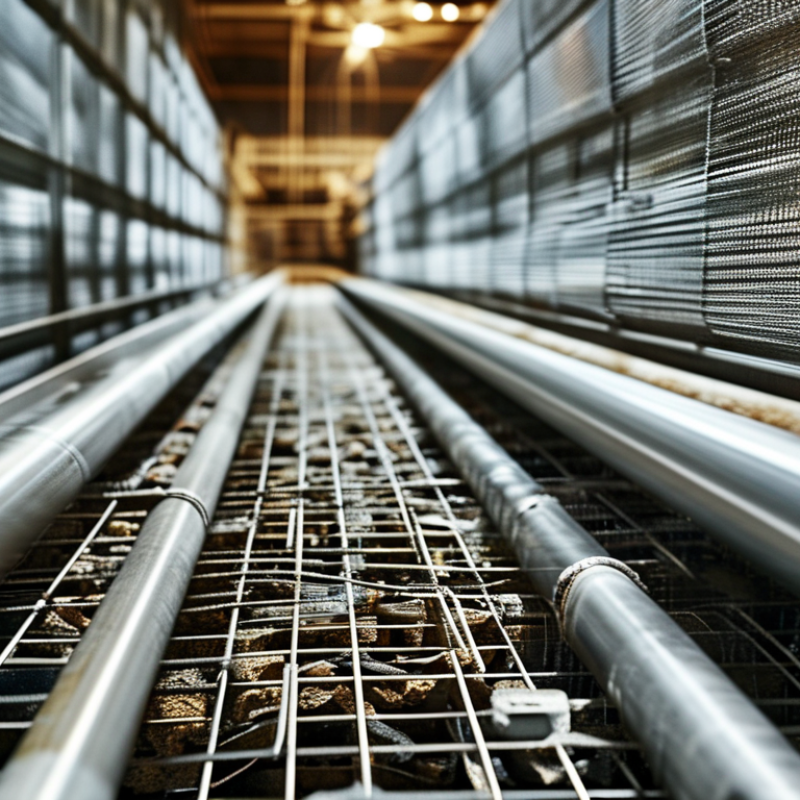
What Industries Use Metal Mesh Products?
Construction remains a major user of metal mesh products. The U.S. Census Bureau reported approximately $2.15 trillion in construction spending during 2024. Concrete work represents a significant share of this activity. Welded wire reinforcement helps distribute tensile stresses across slabs, walls, precast panels, and architectural facades.
ASTM A1064/A1064M-24 covers plain and deformed carbon-steel wire and welded wire reinforcement for concrete. The specification addresses wire properties, dimensions, weld quality, and testing requirements. On a jobsite, crews place mesh on supports before concrete placement. Correct positioning matters. Mesh resting on the subgrade cannot control cracks effectively near the slab’s tensile zone. Small laps and poorly tied intersections can also create weak areas. Simple mistakes happen.
For reinforced concrete facades, mesh can support crack control and improve dimensional stability in thin panels. Engineers still need to verify bar spacing, concrete cover, lap lengths, exposure conditions, and anchorage. ACI 318-19 provides structural design requirements, while project specifications may add stricter durability criteria. The Federal Highway Administration’s 2024 National Bridge Inventory recorded 617,084 U.S. bridges, showing the scale of concrete infrastructure requiring disciplined reinforcement practices. That figure does not mean every bridge uses welded mesh. It does show why consistent material documentation matters. Mill certificates, weld inspections, and dimensional checks provide practical evidence of conformity. Some projects still specify mesh without resolving installation tolerances early. That deserves review.
| Construction Application | Typical Mesh Function | Common Product Form | Representative Design Range* | Relevant Standard or Specification | Primary Performance Benefit | Important Project Considerations |
|---|---|---|---|---|---|---|
| Slabs-on-grade | Controls temperature and shrinkage cracking and helps distribute localized loads. | Welded wire reinforcement sheets or rolls, usually placed near the upper third of the slab where crack control is required. | Wire diameters commonly selected from approximately 4.0–9.5 mm; spacing often 100–300 mm, subject to engineering design. | ASTM A1064/A1064M for carbon-steel wire and welded wire reinforcement; project concrete requirements may also reference ACI guidance. | More uniform crack distribution and faster placement than individually positioned bars in many layouts. | Support the mesh at the specified elevation; do not rely on workers lifting mesh during concrete placement. Account for joints, openings, laps, and exposure conditions. |
| Suspended floors and elevated slabs | Provides distributed reinforcement for flexural demand, crack control, and temperature effects. | Flat welded wire reinforcement panels or prefabricated mats. | Typical wire sizes may range from approximately 5.0–13.0 mm, with spacing selected according to span, loads, and required steel area. | ASTM A1064/A1064M; structural design is governed by the applicable building code and engineered reinforcement schedule. | Consistent two-directional reinforcement and efficient prefabrication for repetitive floor layouts. | Verify development, lap, anchorage, cover, punching-shear requirements, and coordination with penetrations before placement. |
| Precast concrete panels | Controls handling, drying-shrinkage, and service-load cracking in thin or moderately reinforced elements. | Welded wire reinforcement panels, sometimes combined with bars, lifting inserts, or edge reinforcement. | Common spacing is approximately 100–200 mm; wire diameter and layer count depend on panel thickness and lifting design. | ASTM A1064/A1064M for qualifying wire products; concrete and precast production requirements are specified separately. | Repeatable reinforcement geometry and improved production efficiency in factory-controlled conditions. | Check minimum cover, panel lifting points, corner reinforcement, weld integrity, transport stresses, and tolerances. |
| Concrete walls and retaining walls | Controls shrinkage and thermal cracking and supplements reinforcement designed for earth, water, or lateral loads. | Welded wire reinforcement sheets, often used as distributed reinforcement in one or both faces. | Spacing often falls within 100–300 mm; heavier reinforcement may be required at bases, corners, joints, and openings. | ASTM A1064/A1064M, together with the applicable structural concrete code and project drawings. | Provides regular reinforcement distribution and can simplify installation across broad wall areas. | Design must address lateral pressure, water tightness, construction joints, bar development, cover, and drainage details. |
| Concrete façades and architectural panels | Limits cracking caused by restrained shrinkage, temperature variation, handling, and localized service stresses. | Light-to-medium welded wire reinforcement embedded within precast or cast-in-place façade elements. | Typical mesh spacing is approximately 50–200 mm; selection depends on panel thickness, dimensions, exposure, and connection design. | ASTM A1064/A1064M for carbon-steel wire reinforcement; façade attachments and fire or durability requirements are project-specific. | Improves crack control while maintaining relatively consistent reinforcement placement in thin panels. | Coordinate mesh with anchors, embeds, reveals, openings, lifting hardware, architectural surfaces, and required concrete cover. |
| Shotcrete linings and tunnel surfaces | Provides distributed reinforcement for crack control and local stabilization in sprayed concrete layers. | Welded wire mesh fixed to rock bolts, supports, or prepared substrates before shotcrete application. | Frequently used wire diameters are approximately 4.0–8.0 mm with 50–150 mm openings, depending on ground and lining design. | ASTM A1064/A1064M may apply to the mesh product; shotcrete execution and structural criteria follow the project specification. | Helps retain the sprayed layer and provides a visible, regular reinforcement grid. | Control rebound, ensure adequate standoff from the substrate, maintain cover, and verify mesh anchorage and corrosion protection. |
| Pavements and industrial yards | Controls transverse and longitudinal cracking and distributes stresses from traffic or industrial equipment. | Welded wire reinforcement sheets or rolls, with additional load-transfer and joint details where required. | Spacing commonly ranges from approximately 100–300 mm; slab thickness and loading determine the required steel area. | ASTM A1064/A1064M for qualifying wire mesh; pavement design may also reference transportation or project-specific criteria. | Efficient coverage over large areas and consistent placement for crack-control reinforcement. | Mesh does not replace correctly designed joints, subgrade preparation, load-transfer devices, or adequate concrete curing. |
| Water-retaining and drainage structures | Controls crack width and supports reinforcement layouts intended to improve liquid tightness. | Welded wire reinforcement in walls, bases, channels, and cover slabs, typically combined with carefully detailed joints. | Spacing often ranges from approximately 100–200 mm, but crack-width and exposure requirements govern final selection. | ASTM A1064/A1064M for the reinforcement product; liquid-tightness, durability, and joint requirements are separately engineered. | Supports closely spaced reinforcement layouts that can help limit crack width when properly designed and constructed. | Specify concrete permeability, cover, waterstops, joint spacing, curing, corrosion protection, and crack-width limits. |
*Representative ranges are provided for orientation only and are not ASTM A1064/A1064M limits. Final wire size, spacing, reinforcement area, lap length, cover, and corrosion protection must be determined from the project drawings, applicable building code, exposure classification, and structural engineer’s design.
: Concrete slabs, walls, precast panels, and facades commonly use welded wire reinforcement. It distributes tensile stresses and helps control cracking. Placement matters greatly.
Mesh should sit on supports within the slab’s tensile zone. Mesh lying on the ground cannot control cracks effectively. Small laps can also create weak areas.
They should verify wire spacing, concrete cover, lap lengths, exposure, and anchorage. Project specifications may require stricter durability controls. Details matter here.
Mill certificates, weld inspection records, and dimensional checks provide useful evidence. These records support compliance with applicable reinforcement requirements. Documentation is not decoration.
Mesh separates valuable particles from waste rock and process material. Screening decks may face sharp rock, vibration, moisture, and abrasive dust. Conditions can be harsh.
Smaller openings can improve separation but may become blocked by clay. Larger openings reduce blockage but may pass unwanted fragments. The tradeoff is real.
Technicians should use documented measurements rather than visual inspection. A controlled aperture reference supports consistent laboratory and process checks. Looks can mislead.
No. Wear ratings cannot predict every mine condition. Impact damage, poor tensioning, and broken wires may cause early failure. Field evidence still matters.
They should inspect elongated openings, broken wires, loose panels, and damaged edges. Regular sample measurements connect laboratory data with deck performance. Records reveal patterns.
Heavier wire may last longer in abrasive ore. However, it can reduce open area and affect throughput. More metal is not always better.
Understanding what industries use metal mesh products reveals how adaptable these engineered materials are across demanding applications. In construction, mesh can reinforce concrete and support facade systems when designed according to ASTM A1064 specifications. Filtration operations use controlled mesh openings to separate particles, with performance evaluated through methods such as ISO 3310 and ISO 16889. In mining, durable screens help classify ores by aperture size while maintaining wear resistance under harsh conditions and continuous vibration.
Metal mesh also supports hygiene-focused processing in the food and pharmaceutical sectors, where suitable materials and designs can meet FDA 21 CFR 177.1630 requirements. In industrial safety, mesh panels are commonly used as machine guards to help prevent access to hazardous moving parts and support compliance with OSHA 29 CFR 1910.212. Across these industries, selecting the correct wire material, opening size, strength, surface finish, and inspection standard is essential for achieving reliable performance, safety, cleanliness, and long service life.

 Reivanta Mesh