Understanding what is the purpose of protective fencing begins with a practical question: what risk must the barrier control? It may separate pedestrians from moving vehicles, restrict access to hazardous equipment, protect materials, or define a temporary work zone. A fence is not a magic wall. Its value depends on location, height, strength, visibility, gates, lighting, and daily inspection.
Industry data shows why this decision matters. The U.S. Bureau of Labor Statistics recorded 1,075 fatal work injuries in the construction industry during 2023. OSHA continues to identify falls as a leading construction hazard, while struck-by incidents and unauthorized access remain serious site concerns. These figures do not prove that fencing alone prevents injuries. They show why layered controls deserve attention. ISO 31000 also recommends risk-based planning, rather than choosing controls by habit. Protective fencing should support that process.
The best systems are specific. A rigid steel panel may protect a roadside excavation, while high-visibility mesh may guide pedestrians around a temporary event area. Anti-climb features can help at sensitive locations, but they should never create hidden corners or block emergency routes. Gates need controlled closing, clear signs, and reliable access for authorized workers. Field inspections often reveal simple failures: loose feet, missing panels, and gates left open. These details matter. Honestly, fencing is sometimes installed because it looks reassuring, not because it addresses the actual hazard. This article examines the purpose of protective fencing through safety performance, access control, installation quality, and maintenance evidence, while recognizing that no barrier replaces trained personnel, suitable procedures, and continuous risk review.
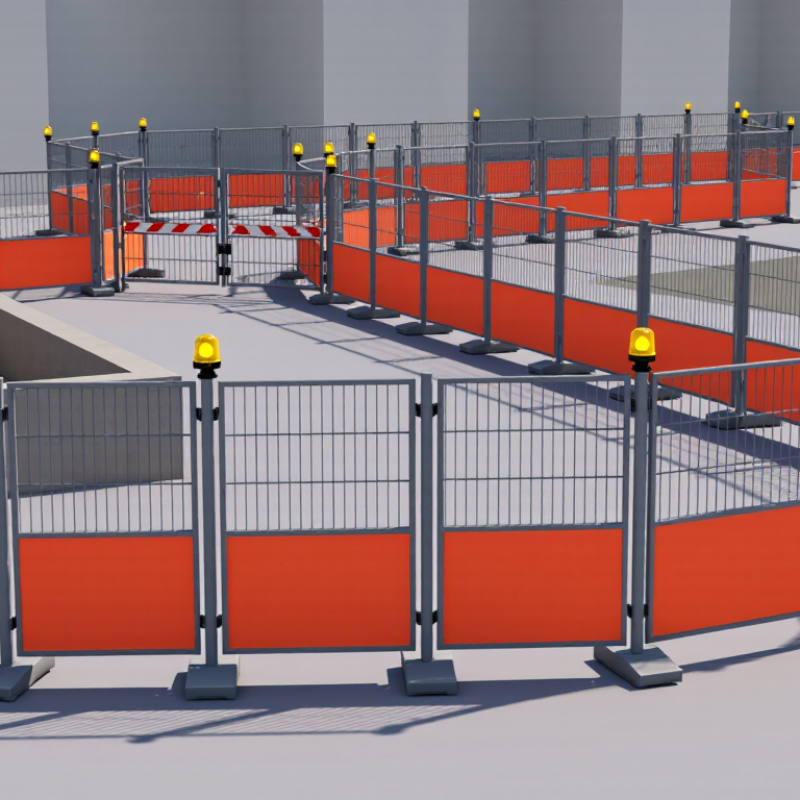
Define the Threat: Intrusion, Safety, Crowd, or Asset-Control Risk
Protective fencing only works when its purpose is clearly defined.
A barrier designed for intrusion resistance may be unsuitable for crowd movement. Start by naming the threat, not selecting a product. Is someone trying to enter? Could people fall, wander, or gather dangerously? Is equipment exposed to unauthorized handling? These questions shape height, visibility, gate control, spacing, and warning signs. Vague goals create expensive barriers that solve the wrong problem.
For intrusion risk, assess approach routes, climbing opportunities, vehicle access, and the value of the protected area.
For safety risk, focus on edge protection, stable foundations, smooth surfaces, and clear escape paths.
Crowd-control fencing needs predictable flow, visible boundaries, and enough space near gates.
Asset-control fencing may need tamper-evident access records and limited entry points.
Field experience matters here.
A site drawing rarely shows delivery delays, blind corners, or people taking shortcuts. Walk the perimeter at busy and quiet times.
Reliable planning also tests the weak points.
Can staff see through the barrier? Does a locked gate slow emergency movement? Will rain, soil movement, or repeated contact loosen the posts? These details are easy to overlook.
I have learned that a strong specification can still fail when daily behavior is ignored. Review the design with operators, maintenance teams, and safety professionals. Document assumptions, inspect installation quality, and revise controls when the threat changes.
No fence remains effective by appearance alone.
Set Opening Sizes Using ISO 13857’s 850 mm Reach-Distance Benchmark
Protective fencing is not merely a physical barrier. It controls how close a person can get to moving machinery, hot surfaces, or stored energy. ISO 13857:2019 provides safety distances for preventing access by limbs. Its 850 mm reach-distance benchmark is a useful design reference when checking openings and nearby hazards. However, it is not a universal opening-size rule. The required distance depends on the opening shape, hazard level, and possible access route.
In practice, measure from the accessible side toward the nearest danger point. A hand may pass through a mesh opening, while an arm reaches farther than expected. Set the opening size only after comparing it with the ISO 13857 tables and completing a documented risk assessment. Keep the fence rigid, inspect loose fixings, and check gaps near hinges, conveyors, and floor edges. Small installation errors matter. A 10 mm shift can change the effective distance in a tight layout.
The need for careful design is supported by wider safety data. The International Labour Organization reported about 2.93 million work-related deaths and 395 million non-fatal work injuries globally in 2023. In Great Britain, HSE statistics for 2023/24 recorded approximately 561,000 non-fatal workplace injuries. These figures do not prove that fencing alone prevents incidents. They show why access control deserves measured engineering, not visual guesswork. I have seen teams treat 850 mm as a magic number. That approach is convenient, but incomplete. Each opening still needs a second look.
How to Understand the Purpose of Protective Fencing? - Set Opening Sizes Using ISO 13857’s 850 mm Reach-Distance Benchmark
The reference values below summarize minimum safety distances for regular openings intended to prevent access to a hazard zone by the upper limbs. The dimensions are expressed in millimetres and should be applied together with the actual hazard location, guard geometry and risk assessment.
ISO 13857 Reference: Regular Opening Size and Minimum Safety Distance
| Opening dimension, e (mm) |
Minimum safety distance, sr (mm) |
Typical access prevented |
Protective-fencing interpretation |
| ≤ 4 |
≥ 2 |
Finger access |
Keep the opening at or below 4 mm, or maintain at least 2 mm to the hazard. |
| > 4 to 6 |
≥ 10 |
Finger access |
Increase the distance from the hazardous point when the opening exceeds 4 mm. |
| > 6 to 8 |
≥ 20 |
Finger access |
Use the greater distance when the mesh or slot dimension is close to 8 mm. |
| > 8 to 10 |
≥ 80 |
Finger access toward the hazard |
A small increase in opening size requires a substantially greater separation distance. |
| > 10 to 12 |
≥ 100 |
Finger or fingertip access |
Do not assess the opening alone; check the complete guard and hazard layout. |
| > 12 to 20 |
≥ 120 |
Finger and partial hand access |
Position the hazard at least 120 mm behind the protective fence. |
| > 20 to 30 |
≥ 200 |
Hand access |
A 200 mm separation is required for openings up to 30 mm. |
| > 30 to 40 |
≥ 850 |
Hand and arm reach |
The 850 mm benchmark becomes the controlling minimum distance for this opening range. |
| > 40 to 120 |
≥ 850 |
Arm reach through the opening |
Maintain at least 850 mm from the accessible opening to the hazardous point, subject to the standard’s applicability conditions. |
How to read e
“e” is the smallest dimension of a regular opening, such as the width of a mesh opening or slot.
How to read sr
“sr” is the minimum distance from the accessible opening to the nearest hazardous point.
Design implication
If the hazard cannot be moved at least 850 mm away, reduce the opening size or use an additional protective measure.
Important: These values are a practical reference for regular openings and are not a substitute for the current edition of ISO 13857, the applicable machinery-safety requirements, or a task-specific risk assessment. Irregular openings, access over or around guards, reach below structures, body access, and safeguarding of special hazards require separate evaluation.
Select Materials Rated for ASTM F567 Installation and Site Conditions
Protective fencing starts with a clear purpose: control access, protect equipment, and guide people safely around a site. ASTM F567 provides installation practices for chain-link fencing. It is not a blanket approval for every fence material. Selection still depends on soil, wind exposure, drainage, corrosion risk, and expected impact.
On active sites, I have seen strong fabric fail because posts were poorly anchored. Loose soil may require deeper foundations or engineered solutions. Wet ground can accelerate corrosion around fittings and cut edges. Choose compatible mesh, posts, gates, fasteners, and coatings. Confirm their performance against the project specification and local conditions. A perfect checklist is not enough. Field judgment matters.
Tips: Inspect the soil before ordering materials. Check drainage after rain. Match coatings across connected components. Review ASTM F567 installation requirements with a qualified installer. Keep records of post spacing, foundation details, tensioning, and site changes.
Measure twice. Install once.
The fence should also suit maintenance realities. Gates need clear swing paths, reliable hinges, and visible access points. Protective barriers near vehicles may need extra visibility or impact planning. Do not assume a heavier material always performs better. Excess weight can increase foundation demands and installation errors. Recheck alignment as concrete cures. Small deviations become obvious along long runs, and correcting them later may be expensive.
Engineer Posts and Foundations Against EN 1991 Wind-Load Requirements
How to Understand the Purpose of Protective Fencing?
Engineer Posts and Foundations Against EN 1991 Wind-Load Requirements
Protective fencing is not merely a visual barrier. It becomes a wind-sensitive structure when panels, mesh, or solid screens catch airflow. EN 1991-1-4 defines the fundamental basic wind velocity as a ten-minute mean wind speed, measured at ten metres in terrain category II, with a 2% annual exceedance probability. Local National Annex values control the final design.
Wind pressure rises quickly. Using the Eurocode reference air density of 1.25 kg/m³, a 30 m/s mean velocity produces about 563 N/m² before exposure and pressure coefficients are applied. The European Commission Joint Research Centre identifies these coefficients as essential for site-specific wind assessment. Engineers should calculate peak velocity pressure, panel force, and overturning moment at each post.
Posts still bend. Foundations often govern.
A practical check includes post spacing, embedment depth, soil stiffness, drainage, and connection strength. A 2.4-metre-high solid panel can create a large lever arm, especially near corners and exposed ridges. Mesh reduces blockage, but it does not remove wind action. EN 1991-1-4 also requires attention to edge zones, turbulence, and force coefficients for free-standing walls and fences.
Design reviews sometimes focus too heavily on steel strength. That is a weakness. A strong post can still rotate in weak soil. Field measurements may also differ from assumed ground conditions. Therefore, geotechnical information, construction tolerances, and inspection records should support the calculation, not sit separately from it.
Reference: CEN EN 1991-1-4:2005+A1:2010 and European Commission Joint Research Centre Eurocodes guidance.
Verify Gates, Clear Zones, and Inspection Intervals After Installation
Protective fencing works only when its gates, clear zones, and inspection routine match the real hazard. After installation, walk the perimeter during normal operations. Check that every gate closes fully, latches securely, and cannot swing into a vehicle route. A small gap can become a serious failure point.
The U.S. Bureau of Labor Statistics recorded 1,069 fatal work injuries in construction during 2023. Falls represented 38.5% of those deaths, according to the Census of Fatal Occupational Injuries.
Fencing cannot prevent every incident, but it can separate people from edges, machinery, and moving equipment. Keep the required clear zone free from pallets, cables, stored materials, and temporary signs. Measure it again after layout changes. OSHA’s machine-guarding requirements also stress preventing access to dangerous moving parts. The fence should support that purpose, not create a false sense of security.
Tips: Test each gate at the start of every shift. Record the latch, hinges, panels, anchors, and warning signs. Set inspection intervals by risk, weather, traffic, and usage. A monthly check may be inadequate near heavy vehicle movement. After strong wind, impact, or relocation, inspect immediately. Photos improve traceability, although they can hide loose anchors. A hands-on check remains necessary. Review the record with operators, because installers may miss practical access problems.
Conclusion
Understanding what is the purpose of protective fencing begins with identifying the specific threat it must control. A fence may be intended to prevent unauthorized intrusion, protect people from hazardous areas, manage crowds, or secure valuable assets. Its design should therefore reflect the site’s risks, expected traffic, visibility requirements, and operating conditions rather than relying on a one-size-fits-all solution.
Effective planning also includes setting opening sizes according to ISO 13857’s 850 mm reach-distance benchmark, selecting materials suitable for the environment and rated for ASTM F567 installation practices, and engineering posts and foundations to withstand wind loads assessed under EN 1991. After installation, the system should be checked for reliable gates, unobstructed clear zones, stable connections, and appropriate inspection intervals. Regular reviews help identify corrosion, impact damage, loosened components, or changing site conditions, ensuring the fencing continues to provide dependable protection throughout its service life.

 Reivanta Mesh